What age are bilingual vocabulary cards best for?
Bilingual vocabulary cards can be useful at many stages of childhood, but the best age depends on a child’s language development, attention span, and learning goals. These cards introduce a word in one language alongside its meaning or equivalent in another language, making it easier for children to connect new vocabulary with familiar ideas.
Parents and teachers sometimes wonder whether vocabulary cards are better for toddlers, preschoolers, elementary-age children, or older students. The good news is that there is no single age when children must start. Bilingual learning can begin very early when activities are simple, playful, and appropriate for the child’s development.
The key is not simply the child’s age. It is how the cards are introduced and how they fit into everyday language experiences.
What Are Bilingual Vocabulary Cards?
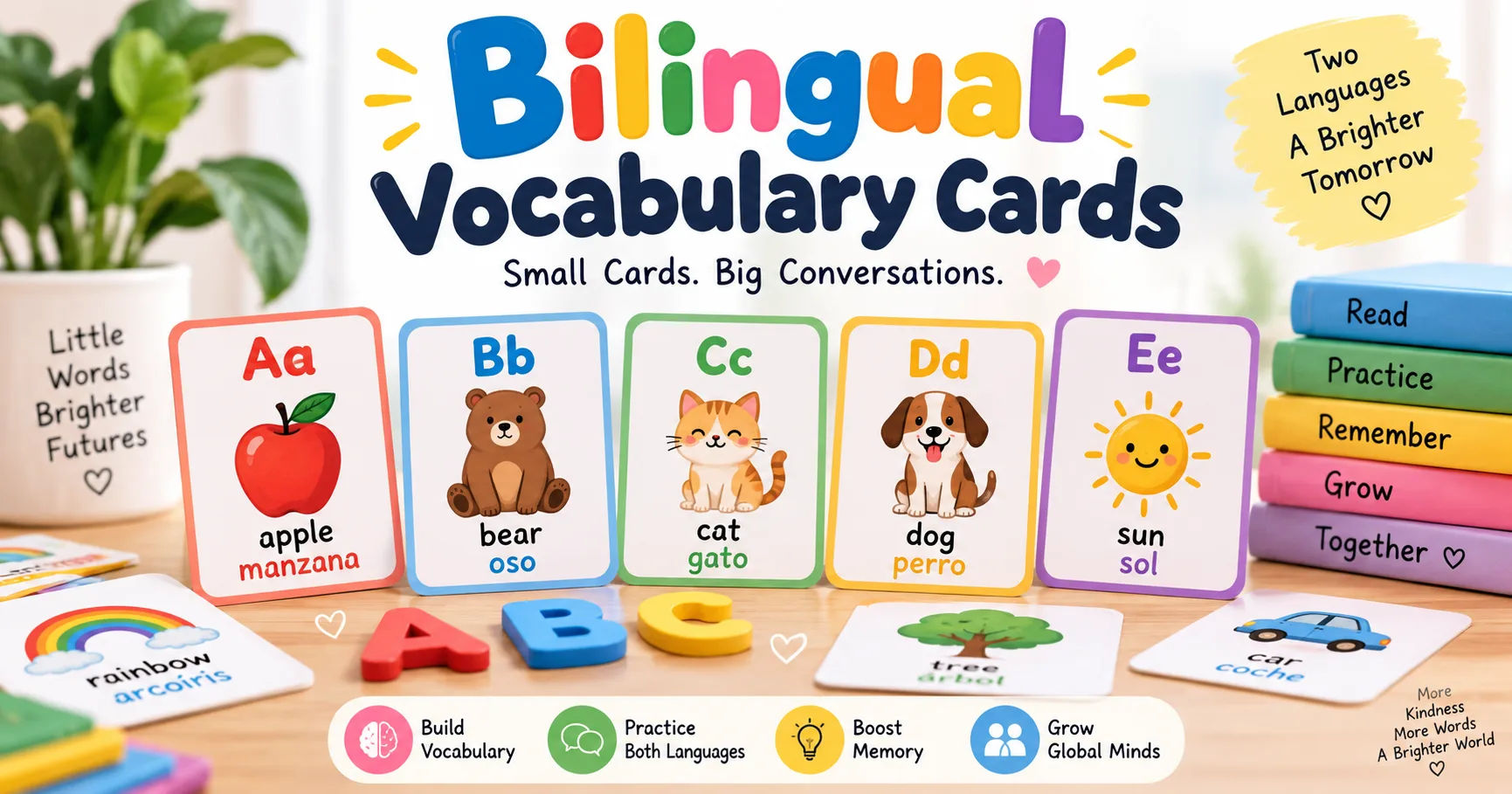
Bilingual vocabulary cards are learning cards that present words in two languages. A card might show a picture of an apple, for example, with the word “apple” in English and its equivalent in another language.
Some cards focus on individual vocabulary words, while others include pictures, short phrases, pronunciation guides, or simple sentences.
The visual element is especially helpful for younger children. Instead of memorizing an unfamiliar word without context, a child can connect the word with an object, animal, action, color, or everyday situation.
These cards can be used at home, in classrooms, during language lessons, or as part of informal play.
What Age Is Best for Bilingual Vocabulary Cards?
There is no universal starting age. However, different age groups can benefit from different approaches.
Babies and Toddlers: Around 0 to 3 Years
Very young children can be exposed to two languages from infancy. At this stage, however, vocabulary cards should not be treated like formal flashcard lessons.
Babies learn primarily through interaction, repetition, sounds, facial expressions, and their surroundings. Parents can show a simple picture card and say the word naturally in both languages.
For example, a parent might show a picture of a cat and say the word in English and then in the family's other language.
The goal is familiarity rather than testing.
Toddlers may enjoy pointing to pictures, naming objects, and repeating words. Short sessions are usually more suitable than long study periods.
Preschoolers: Around 3 to 5 Years
The preschool years are often a particularly useful stage for structured vocabulary activities. Children are developing larger vocabularies and becoming better at identifying objects, categories, colors, animals, foods, and actions.
At this age, bilingual vocabulary cards can become part of a game.
A parent might show a picture and ask, “What is this?” The child can answer in either language, depending on the learning goal.
Cards can also be sorted into groups. Children might separate animals from foods or identify objects that belong in a bedroom, kitchen, or classroom.
Keeping the activity playful helps children remain interested.
Early Elementary Years: Around 5 to 8 Years
Children between five and eight can usually handle more structured vocabulary practice. They can begin learning not only individual words but also simple phrases and sentences.
At this stage, cards can include vocabulary related to school subjects, hobbies, family, weather, transportation, clothing, and everyday activities.
For example, a card might introduce the word “rain” in both languages and then encourage the child to use it in a short sentence.
This moves learning beyond recognition and toward actual communication.
Older Children: Around 8 to 12 Years
Older children can use vocabulary cards in increasingly sophisticated ways. They may benefit from cards that include verbs, adjectives, academic vocabulary, emotions, and more abstract concepts.
Instead of simply showing a picture, a card could include a word, its translation, a definition, and a sample sentence.
Children can also create their own cards. Writing the word, translation, and example sentence gives them another opportunity to process the vocabulary.
At this age, cards can also support school assignments and independent language study.
Teenagers: 13 Years and Older
Teenagers can continue using bilingual cards, particularly when learning a new language or expanding academic vocabulary.
The content should become more age-appropriate. Cards about basic colors and animals may feel too simple for an advanced learner, while cards featuring idioms, academic terms, literature vocabulary, or conversational expressions may be more useful.
Digital vocabulary cards can also appeal to teenagers because they allow learners to review words quickly using a phone, tablet, or computer.
Why Do Bilingual Vocabulary Cards Help?
One major advantage of vocabulary cards is that they provide a clear connection between a word and its meaning.
A picture can make an unfamiliar word easier to understand. Seeing the same concept represented in two languages can also help learners recognize relationships between languages.
Repeated exposure matters as well.
A child may not remember a new word after seeing it once. When the word appears again during reading, conversation, play, or another card activity, recognition can become stronger.
How Language Exposure Affects the Best Age
Children who regularly hear two languages at home may approach bilingual vocabulary activities differently from children who are beginning a second language for the first time.
A child growing up hearing both languages may already understand many words before learning to say them. In that situation, cards can help strengthen vocabulary and encourage active use.
A child with limited exposure to the second language may need more repetition and context.
This is why age alone cannot determine the ideal learning approach.
The child's existing language experience matters just as much.
Choosing Cards According to Developmental Stage
Cards for Younger Children
For toddlers and preschoolers, choose cards with large, clear pictures and familiar objects.
Useful topics include:
-
Animals
-
Food
-
Family
-
Colors
-
Numbers
-
Body parts
-
Toys
-
Clothing
-
Household objects
Keep the wording simple.
Young children generally benefit more from hearing and using words than from being asked to memorize long vocabulary lists.
Cards for School-Age Children
Elementary-age children can work with broader vocabulary.
Cards might include:
-
School subjects
-
Nature
-
Transportation
-
Sports
-
Emotions
-
Daily routines
-
Community places
-
Common verbs
-
Descriptive words
Adding simple sentences can make the activity more meaningful.
Cards for Older Learners
Older learners can use more advanced vocabulary related to science, history, literature, technology, travel, and communication.
Cards can also include synonyms, antonyms, definitions, pronunciation information, and example sentences.
The objective gradually shifts from basic word recognition to accurate and flexible language use.
Should Parents Start With One Language or Two?
When using bilingual vocabulary cards, parents do not necessarily need to separate languages completely.
For a young child, it can be helpful to introduce a concept naturally in both languages.
For example, when teaching the word for “bird,” the parent can show a picture, name the bird in one language, and then give the equivalent word in the second language.
The parent can then use the word during a real conversation.
This creates a connection between the card and everyday communication.
How Long Should a Card Session Last?
The ideal session depends on the child's age and attention span.
For toddlers, a few minutes may be enough. Preschoolers might enjoy several short activities throughout the day.
Older children can usually handle longer review sessions, particularly when the material is connected to their interests.
There is no need to force a child to continue once they become frustrated or bored.
Short, consistent practice is often easier to maintain than occasional, lengthy sessions.
Making Vocabulary Cards More Interactive
Simply showing cards repeatedly can become boring. Parents can turn them into games.
A matching game can ask children to connect a picture with the correct word.
A memory game can involve placing cards face down and finding matching vocabulary.
Parents can also hide cards around a room and ask children to find specific objects or words.
Another approach is storytelling.
Choose several cards and ask the child to create a short story using the words. This encourages vocabulary recall while also developing creativity and communication skills.
Bilingual Vocabulary Cards and Reading
Vocabulary learning becomes more powerful when cards are connected to books.
Suppose a child is reading a story about animals. Before reading, a parent can introduce several animal words using cards.
After reading, the child can look for those words or concepts in the story.
This gives vocabulary a meaningful context.
For bilingual families, reading the same story in both languages can provide additional exposure and help children notice similarities and differences between the two languages.
Common Mistakes to Avoid
One common mistake is expecting children to memorize too many words at once.
Young learners need repetition. Introducing five useful words and practicing them several times may be more productive than presenting twenty unfamiliar words in one session.
Another mistake is focusing too heavily on correct answers.
Language learning involves experimentation. Children may pronounce words incorrectly or mix languages while developing their skills.
A supportive environment gives them opportunities to try again without making every activity feel like a test.
Parents should also avoid choosing cards solely because they look attractive. The vocabulary should be relevant to the child's age, interests, and language level.
How Parents Can Know When Cards Are Working
Progress does not always mean that a child can immediately translate every word.
A child might first recognize a picture, then understand the word when hearing it, and only later say the word independently.
These are all meaningful steps.
Parents can watch for signs such as increased recognition, more frequent use of new words, improved understanding of simple instructions, and greater confidence when using the second language.
Progress should be considered over time rather than after one or two sessions.
Are Physical or Digital Cards Better?
Both formats can be useful.
Physical cards are easy to use away from screens and can become part of games involving movement and interaction.
Digital cards may offer pronunciation recordings, animations, audio repetition, and interactive exercises.
The better option depends on the learner and the purpose.
For very young children, physical cards combined with a parent's voice and interaction can create a simple learning experience. Older children may appreciate digital features that allow independent practice.
The important factor is meaningful language exposure rather than the technology itself.
Tips for Parents Raising Bilingual Children
Parents do not need to turn every moment into a formal lesson.
Daily routines provide many opportunities for language development. Mealtimes, shopping, cooking, reading, traveling, and playing can all introduce vocabulary naturally.
Cards can support these experiences rather than replace them.
For example, before cooking, parents can review cards showing common ingredients. During the activity, they can use those same words in conversation.
This helps children understand that language is something they use to communicate, not simply something they memorize.
Frequently Asked Questions
Can babies use bilingual vocabulary cards?
Yes. Babies can be exposed to pictures and words, but the activity should be brief and interactive. At this age, conversation, songs, books, and everyday communication remain especially important.
Are preschool years a good time to start?
Yes. Preschool children can often engage with simple cards through games, picture identification, repetition, and storytelling. Cards should match their developing attention span and vocabulary.
Can older children still benefit from vocabulary cards?
Absolutely. Older learners can use cards for advanced vocabulary, academic terms, phrases, idioms, and subject-specific language.
How many words should a child learn at one time?
There is no fixed number that works for every child. Starting with a small group of useful words allows children to practice them repeatedly before introducing additional vocabulary.
Should children translate every word?
Not necessarily. Translation can be helpful, but pictures, gestures, examples, and real-life experiences can also communicate meaning. A balanced approach can help children understand words rather than simply memorize translations.
Conclusion
So, what age are bilingual vocabulary cards best for? They can be introduced from infancy and adapted throughout childhood and adolescence. The most appropriate format changes as children grow.
For babies and toddlers, cards work best as a playful introduction to sounds and familiar concepts. Preschoolers can use them through games and repetition. Elementary-age children can begin practicing phrases and sentences, while older learners can use cards for academic and advanced vocabulary.
The most important factor is not finding a perfect age. It is choosing material that matches the learner's development and providing regular opportunities to hear, understand, and use both languages.
When bilingual vocabulary cards are combined with conversations, books, play, songs, and everyday experiences, they can become a practical part of a broader language-learning routine. The goal is to make vocabulary meaningful, enjoyable, and useful in real communication.